Copart max bid calculator
How to calculate your max bid on Copart

Every profitable Copart flip starts with one number: the highest bid you can place and still hit your profit target. Not a guess. Not "I'll stop at $8k." A real ceiling backed by market data, repair costs, and every fee Copart charges before and after the hammer drops.
This is the same math serious flippers use — and the same logic built into AuctionCalc's max bid calculator. Whether you use a spreadsheet or software, you need these five inputs.
The max bid formula
Each variable matters. Skip one and you'll overbid — the most common reason salvage flips lose money.
1. Exit value (what you can actually sell it for)
Do not use KBB "retail" or a random Facebook listing. Use real sold comps for the same year, make, model, trim, and mileage band in your market. Certified pre-owned transaction data is ideal because it reflects what buyers actually paid, not asking prices.
If the car needs a rebuilt title, discount exit value accordingly — typically 20–40% below clean-title comps depending on damage history and your state.
2. Repair costs (parts + labor)
List every damaged panel from the Copart photos and condition report. For each part, estimate:
- Parts cost — eBay, Car-Part salvage yards, or OEM list
- Labor hours — body, paint, mechanical, alignment
- Hidden damage buffer — add 10–20% for what photos don't show (airbags, suspension, sensors)
Front-end hits often look like "$3k in parts" until you open the hood and find radiator, condenser, and ADAS sensors. AI damage analysis from listing photos catches a lot of this early — that's why tools like AuctionCalc scan Copart images before you bid.
3. Copart buyer fees
Your winning bid is not your out-the-door cost. Copart charges:
- Gate / environmental fees
- Virtual bid fee (online buyers)
- Buyer fee (tiered by sale price)
- Title / documentation fees
- Storage after free days
On a $10,000 winning bid, total fees often add $1,200–$1,800+ depending on membership level and location. See our full Copart buyer fees breakdown for 2026 for every line item with a worked example.
4. Transport and holding costs
Factor in towing or transport from the Copart yard to your shop, plus insurance and storage while you repair. Even $50/day in shop rent adds up on a three-week build.
5. Target profit margin
Decide your minimum profit before the auction starts. Many full-time flippers target $2,500–$5,000 net per unit; part-timers might accept less on easier builds. Your max bid shrinks as your margin requirement grows — that's the point.
Worked example
2022 Honda Accord, front-left collision, 48k miles:
- Exit value (rebuilt title comps): $22,500
- Repairs (fender, bumper, headlight, radiator, paint, alignment): $4,800
- Copart fees + transport: $1,650
- Holding / misc: $400
- Target profit: $3,000
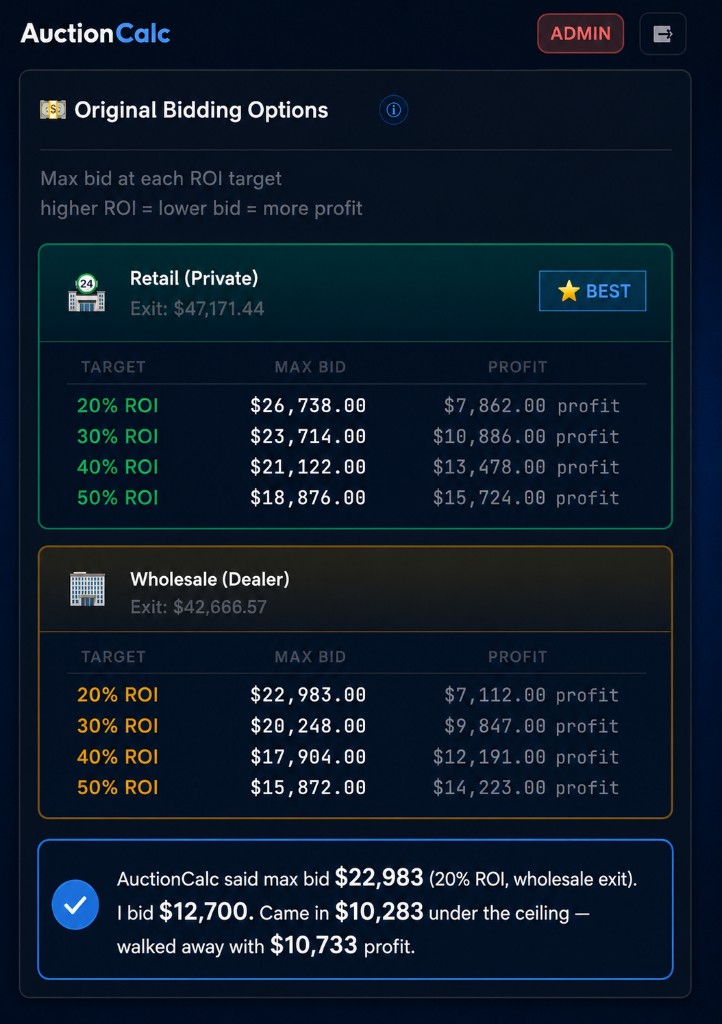
If bidding goes past $12,650, you walk. No exceptions. The dealers who go broke are the ones who "stretch just this once."
Why spreadsheets break at volume
The formula is simple. The execution is not. Each Copart lot has different damage, different comps, different fee tiers, and different parts availability. Doing this manually for every VIN takes 30–60 minutes per car. At 10 cars a week, that's a full-time job before you buy a single vehicle.
That's why flippers use a Copart max bid calculator that pulls market data, estimates repair costs from photos, and outputs a bid ceiling in under a minute.
Calculate your max bid in 60 seconds
Enter a VIN. AuctionCalc pulls comps, analyzes Copart damage photos, and shows your bid ceiling with margin built in.
Analyze Your First VIN FreeCommon mistakes
- Bidding without repair estimate — "looks minor" is not a number
- Using retail pricing — overstates exit value and inflates max bid
- Forgetting fees — a $500 oversight on every deal adds up fast
- No walk-away number — auction fever kills margins
- Ignoring title type — salvage vs rebuilt changes your buyer pool
Next steps
See how to use AuctionCalc on a real Copart listing, read our guide on how to flip cars from Copart step-by-step, salvage car profit calculator to work backward from a bid to real ROI, Copart buyer fees explained, Copart vs IAA for flippers if you're choosing which auction to buy from, or compare AuctionCalc vs other Copart tools if you're evaluating software.